
By the PetsTEK Training Team · Updated October 2026
This site is by PetsTEK, the dog training gear store. The collars below are products we sell. This page answers one question: what actually helps when your dog ignores you — and when the answer is not a collar at all? Every price and spec below was checked against live PetsTEK listings on October 31, 2026 — click through for the current price and stock. We have not hands-on tested these collars on stubborn dogs ourselves; the picks below are judged on verified specs, level control, and boost design, not on claimed testing. A training collar reinforces a command the dog already knows. It does not create motivation, and it does not fix a command the dog was never taught properly in the first place.
Quick answer: For most stubborn dogs, buy the Mini Educator ET-300 ($199.99): 100 levels of fine control with Boost 1–60, so you can find the exact level your dog notices instead of jumping from ‘ignored’ to ‘too much,’ plus a Pavlovian tone you can train as the cue itself. For a strong, driven dog, the Dogtra 1900X ($254.99) adds low-high output and a dial remote you can adjust by feel. For the lowest price, the SportDOG FieldTrainer 425X ($154.99) gives 21 levels and 500 yards. But first, read the reframe below: most ‘stubborn’ dogs are not defiant — they are distracted, under-motivated, or unclear on what you actually want. A higher level fixes none of those three. Fix motivation and clarity first, then use the collar to proof a command the dog already understands.
‘Stubborn’ is the word owners use for at least four different dogs, and each one needs something different. There is the distracted dog — perfect recall in the kitchen, deaf at the park gate, because the command was never proofed against real distractions. There is the under-motivated dog — the treat you offer is worth less to the dog than the squirrel, the other dog, or the smell on the ground, so the dog makes a rational choice and you lose. There is the unclear dog — the command means three different things on three different days, or the whole family uses different words, so the dog guesses and guesses wrong. And there is the genuinely driven dog — a high-drive breed that will push through discomfort for something it wants, where a low, vague level genuinely does not register. Only the last dog is a collar-strength problem. The first three are training problems, and buying a stronger collar for them is how owners end up escalating levels, frustrating the dog, and calling the dog stubborn a second time. The collars below are judged on what a stubborn dog actually needs: a scale fine enough to find the working level precisely, a boost mode for the rare high-distraction moment (not the daily setting), a tone or vibration cue the dog can graduate to, and a remote that stays consistent in your hand.
First, Is Your Dog Actually Stubborn? The 5-Factor Check
- Goal — pick one behavior, and train that one behavior at a time.
- Size and build — check fit high behind the ears, with both contact points touching skin, before concluding anything.
- Age — a puppy under 6 months is not stubborn; use positive reinforcement first, and no collar yet.
- Temperament — a fearful or anxious dog that freezes or runs is stressed; see a vet or behaviorist first.
- Health — pain, hearing loss, thyroid or neurological issues can look like ignoring; get a vet visit before a collar.
If the check points to distraction or motivation, try the fixes below for two weeks before you buy. If it points to a driven dog that knows the command, ignores it anyway in high distraction, and needs a precisely set level — that is the dog this page is for.
Check the Basics First: The Fixes That Cost Nothing
- Raise the reward, not the level — real meat, cheese, or a favorite toy, delivered the instant the dog turns toward you.
- Shorten the session — five focused minutes beat twenty bored minutes; end while the dog is still winning.
- Be consistent — one word, one meaning, every time, from every person in the house.
- Proof in stages — kitchen, yard, quiet street, park, park with other dogs.
- Exercise first — a tired dog is a trainable dog.
- One behavior at a time — train that one behavior before adding another.
Start Low, Go Slow: The Stubborn-Dog Conditioning Sequence
- Weeks 1–2 (or up to 4) — wear the collar with zero corrections, fit high behind the ears, and train the one chosen behavior on a long line with high-value rewards.
- Pair the cue — tone or vibration first, then reward, until the dog responds to tone or vibration alone.
- Find the working level at home, not at the park — start at the bottom, and look for the first mild reaction: an ear flick, a head turn, or a brief pause. Never copy a level from another owner or brand.
- Understand two-tier stimulation — the general scale is the daily working range; boost is a separate higher step for the rare high-distraction moment on a known command — ET-300 Boost 1–60, 1900X Boost. If you live on boost, your working level is wrong.
- Proof in stages, one distraction at a time, and phase it out — mix collar-on and collar-off sessions, and watch for collar-smart behavior.
- Watch your timing — a correction landing after the behavior ends, or while frustrated, teaches nothing except unpredictability — the timing-failure trap. If you missed the moment, let it go and set up the next repetition properly.
Quick Answer: Which Collar for Which Stubborn Dog
| Your situation | Pick | Why |
|---|---|---|
| Most stubborn dogs, finest level control | Mini Educator ET-300 | 100 levels, Boost 1–60, Pavlovian tone, fits all sizes |
| Strong, driven dog | Dogtra 1900X | Low-high output, 100 levels, Boost, dial remote by feel, 35 lbs+ / 13 inch+ necks |
| Stubborn dog at field distance | Garmin PRO 550 | 1 mile, Momentary + Continuous, 21 levels, trains up to 3 dogs |
| All-rounder | Garmin Sport PRO | 3/4 mile, beacon lights, BarkLimiter, bundle (10-level scale is coarse) |
| Stubborn dog on a budget | SportDOG FieldTrainer 425X | 500 yards, 21 levels, $154.99 |
| First collar, simplest controls | PetSafe 900 Yard | 900 yards, safety lock, neck fit up to 27 inches |
The Six Collars Compared
| Collar | Best for stubborn dogs | Range | Stim Levels and Modes | Shock Function | Stubborn-dog fit | Check price | |
|---|---|---|---|---|---|---|---|
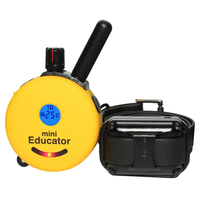 | Mini Educator ET-300 — $199.99 | Best overall | 1/2 mile | 100 levels; Nick, Continuous, Vibration, Pavlovian tone, Boost 1–60 | Yes | Finest control, fits small, medium, and large dogs, customizable contact points | Check price → |
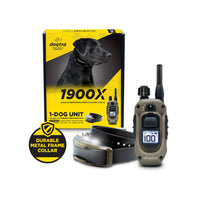 | Dogtra 1900X — $254.99 | Strong, driven dog | 3/4 mile | 100 levels; Nick, Continuous, XPP vibration, Tone, Boost | Yes | Low-high output, robust receiver, 35 lbs+, neck 13 inch+ | Check price → |
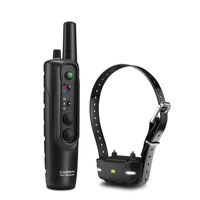 | Garmin PRO 550 — $399.99 | Field distance | 1 mile | 21 levels; Continuous, Momentary, Tone, Vibration, beacon lights, BarkLimiter | Yes | Field build, trains up to 3 dogs | Check price → |
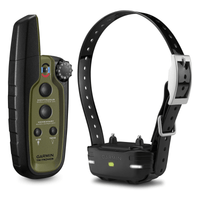 | Garmin Sport PRO Bundle — $299.99 | All-rounder | 3/4 mile | 10 levels; Continuous, Momentary, Vibration, Tone, beacon lights, BarkLimiter | Yes | Field build, trains up to 3 dogs, coarsest scale here | Check price → |
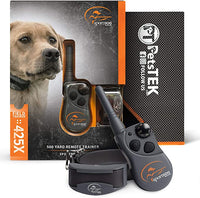 | SportDOG FieldTrainer 425X — $154.99 | Best value | 500 yards | 21 levels; Nick, Constant, Tone, Pager vibration | Yes | 8 lbs+, DryTek waterproof, expands to up to 3 dogs | Check price → |
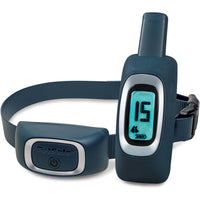 | PetSafe 900 Yard Remote Trainer — $199.95 | Simplest system | 900 yards | 15 levels; Tone, Vibration, Static; safety lock | Yes | 8 lbs+, neck 6 inch to 27 inch, expands to 2 dogs | Check price → |
A stim number is NOT comparable across brands — the ET-300’s 100 levels, the PRO 550’s 21, and the Sport PRO’s 10 are different scales. Compare how finely you can find your dog’s working level, whether there is a boost step for high-distraction moments, and whether the remote stays consistent in your hand — not raw level counts. Advertised range is line-of-sight best case — hills, trees, and buildings cut real-world range. Prices checked against live PetsTEK on October 31, 2026 — click through for the current price and stock. Source: petstek.com live listings.
Shop the full range of remote training collars at PetsTEK →
The Picks in Detail
Mini Educator ET-300 — Best Overall ($199.99)
The ET-300 is the finest level control here: 100 levels, Boost 1–60, Pavlovian tone, vibration, Nick and Continuous, with customizable contact points and a fit for small, medium, and large dogs. That fine scale is what a stubborn dog needs most — you can find the exact level your dog notices, instead of jumping from ‘ignored’ to ‘too much.’ Its limit is range, not control: at 1/2 mile it covers yard, park, and neighborhood training, but it is not a field-distance system.
Choose if: you want the finest level control, a tone you can train as the cue itself, and a collar that fits all sizes.
Who should skip it: field trainers who need a mile of range — the Garmin PRO 550 below is the field-distance pick.
View Mini Educator ET-300 on PetsTEK →
Dogtra 1900X — Best for a Strong, Driven Dog ($254.99)
The 1900X is built for a strong, driven dog: a robust receiver, low-high output, 100 levels, Boost, a dial remote you can adjust by feel, and a fit for large dogs at 35 lbs+ with 13 inch+ necks. Its limit is the floor, not the ceiling: a small dog under 35 lbs is a bad match for this receiver. If you have a smaller dog, check fit first and read our small-dogs guide before choosing this one.
Choose if: your dog is 35 lbs or more, you train outdoors, and you want a dial remote and a rugged receiver for a driven dog.
Who should skip it: owners of a small dog under 35 lbs, or anyone training only in the yard — the PetSafe 900 or 425X below does that work for less.
View Dogtra 1900X on PetsTEK →
Garmin PRO 550 — Best for a Stubborn Dog at Field Distance ($399.99)
The PRO 550 is the field-distance pick: a full mile of range, 21 levels, Momentary tap versus Continuous sustained cue, Tone, Vibration, LED beacon lights, and a built-in BarkLimiter with AutoRise, training up to 3 dogs. The trade-off is price and bulk: it is the most expensive collar on this page, and it is overkill for yard-only training.
Choose if: you train at field distance, you hunt or work a dog in open country, or you want bark control built in.
Who should skip it: yard and neighborhood trainers — a mile of range you never use is money spent on nothing, and the Sport PRO or 1900X is the better buy.
View Garmin PRO 550 on PetsTEK →
Garmin Sport PRO — Best All-Rounder ($299.99)
The Sport PRO is the field all-rounder in a bundle: collar plus handheld, 3/4-mile range, Continuous and Momentary stimulation, Vibration, Tone, LED beacon lights, and a built-in BarkLimiter, training up to 3 dogs. Its honest limit is its 10-level scale — the coarsest here — so if you need very fine level differences, the ET-300 or 1900X is the better first system.
Choose if: you train in the field, you want bark control built in, or you work in low light and want the beacon lights.
Who should skip it: pairs that need fine-grained level differences, or first-time buyers on a tight budget — the 425X does that work for less.
View Garmin Sport PRO on PetsTEK →
SportDOG FieldTrainer 425X — Best Value ($154.99)
The 425X is the lowest-priced collar on this page: 500 yards, 21 levels, Nick and Constant stimulation, Tone and Pager vibration, for dogs 8 lbs+, expandable to up to 3 dogs. The remote takes a session or two to learn by feel, and its limits are range and receiver toughness compared with the field systems above.
Choose if: budget matters, you train in yards, parks, and fields under 500 yards, or this is your first collar.
Who should skip it: owners who need a mile of range, or who want the toughest receiver on this page — pay the extra for the 1900X or PRO 550.
View SportDOG FieldTrainer 425X on PetsTEK →
PetSafe 900 Yard — Simplest System ($199.95)
The PetSafe 900 is the simplest system here: 900 yards, 15 levels of Tone, Vibration, and Static, with a safety lock that stops level drift, for dogs 8 lbs+ with neck fit from 6 inch to 27 inch, expandable to a 2-dog system. Its widest neck range makes it an easy first collar. Its limits are range and ruggedness compared with the field systems, and it has no beacon light.
Choose if: this is your first training collar, you train in the yard or neighborhood, or your dog’s neck is at the wider end of the range.
Who should skip it: field trainers — buy range once with the Sport PRO or 1900X instead of outgrowing this one.
View PetSafe 900 Yard on PetsTEK →
Buying Guide: Look For / Avoid
Fine scale
Look for: a scale fine enough to find your dog’s working level precisely. Avoid: judging a collar by raw level count alone — scales are not comparable across brands.
Boost step, not a boost lifestyle
Look for: a boost step for the rare high-distraction moment on a known command. Avoid: living on boost — if you need it every time, your working level, reward, or distraction stage is wrong.
Tone or vibration cue to graduate to
Look for: a tone or vibration cue the dog can graduate to, so stimulation is not the only cue. Avoid: a system with no non-stimulation cue to pair with your voice command.
Consistency in your hand
Look for: a remote that stays consistent in your hand — a dial remote you can adjust by feel, or a safety lock that stops level drift. Avoid: a remote whose level you can change by accident mid-session.
Motivation before hardware
Look for: a motivation and clarity fix first — higher-value rewards, shorter sessions, and consistent words. Avoid: buying a stronger collar for a distracted, under-motivated, or unclear dog.
Ergonomics under distraction
Look for: a remote you can operate without looking at it while a dog is already moving away. Avoid: a remote you have to study mid-session.
When NOT to Use One — and What to Try Instead
- The command is not learned yet — teach it on-leash first, one command at a time.
- The dog is fearful or anxious — see a vet or behaviorist first.
- The dog is under 6 months — positive reinforcement first, no collar yet.
- There are fear or aggression problems — work with a professional trainer or behaviorist first.
- The dog yelps, freezes, or shuts down — stop; the level is too high or the dog is not ready.
- The problem is really motivation — fix the reward and clarity first, before any collar.
Alternatives to try instead: higher-value rewards and shorter sessions; long-line training with staged distractions; a vibration-only approach for a sensitive dog; more exercise and enrichment; and a professional trainer or behaviorist for fear, aggression, or separation anxiety. See also How to Use a Training Collar Safely.
Free PDF: The 7-Day E-Collar Training Plan
Day 1 is fit + beep-only conditioning. Vibrate comes on Days 2–3. Low-stim recall on Days 4–5. Proofing on Days 6–7. For a stubborn dog, the conditioning weeks before Day 1 matter most: wear the collar with zero corrections for 2–4 weeks, pair tone with the one command you chose until the dog answers tone alone, and only then proof it against real distractions — one distraction at a time.
Frequently Asked Questions
Is my dog stubborn, or just untrained?
Usually the second one, or distracted, or under-motivated — and the fix is different for each. A dog that obeys in the kitchen and ignores you at the park has not had the command proofed against real distractions in stages. A dog that ignores you for a squirrel is making a rational choice because the squirrel beats your treat. A dog that hears three different words for one command from three different people is guessing, not defying you. Try higher-value rewards, shorter sessions, consistent words, and staged distractions for two weeks before you conclude the dog is stubborn.
Will a higher stimulation level fix a stubborn dog?
Only if the problem is genuinely that the dog cannot feel the current level — and that is rarer than owners think. More often the dog is distracted, the reward is too weak, the fit is wrong so the contact points are not touching skin, or the command was never proofed at that distraction level. Turning the level up on a distracted or confused dog teaches fear or shutdown, not the command. Find the lowest level the dog notices at home first, then proof the command in stages.
What is boost mode, and should I use it every time?
Boost is a separate, higher step above your normal working level — for example, Boost 1–60 on the Mini Educator ET-300 — reserved for the rare moment a strong distraction overwhelms the working level, on a command the dog already knows. Do not use it as the daily setting: if you need boost every time, your working level is wrong, your reward is too weak, or the distraction is too hard for the stage you are at, and the dog will habituate to boost too.
My dog obeys with the collar on and ignores me without it. What went wrong?
That is called collar-smart behavior, and it happens when the collar becomes the cue instead of your voice. Prevent it by pairing tone with your voice command from the start, using tone alone more and more, and mixing collar-on and collar-off sessions on a long line as the command improves. If the dog already only obeys with the collar on, go back a step and rebuild the command on the long line without the collar.
How long before a stubborn dog starts listening with a training collar?
Plan on 2–4 weeks of wearing the collar with zero corrections while you condition tone and vibration, then several more weeks of proofing one behavior at a time against staged distractions. A dog that ‘suddenly’ listens on day one was usually already trained and just needed a clearer cue; a genuinely stubborn or highly distracted dog takes longer, and rushing the stages is what creates shutdown or collar-smart behavior. Short, winning sessions beat long, frustrating ones every time.
Is it safe to use a training collar on a stubborn dog?
It depends on how it is used, not on the tool alone. At a low working level found at home, with a known command, correct timing, and rewards, a training collar is a communication tool. At high levels, as punishment after the fact, on a fearful or anxious dog, or on a dog that never learned the command, it is harmful — and that use should stop. If you are unsure whether your dog is a good candidate, work with a professional trainer before you start.
Are shock collars cruel?
It depends on how it is used, not on the tool alone. At a low working level, with a known command, correct timing, and rewards, a training collar is a communication tool. At high levels, as punishment after the fact, on a fearful or anxious dog, or on a dog that never learned the command, it is harmful — and that use should stop. The research most often cited in this debate includes Cooper et al. (2014) and Schilder & van der Borg (2003), and both point the same way: timing and level matter more than the device itself. If you are unsure, work with a professional trainer before you start.
Related Guides
- Best Shock Collar for Dogs
- Best Shock Collar for Dogs That Run Away
- Best Shock Collar for Large Dogs
- Best Shock Collar for Thick Fur
- Best Shock Collar for 2 Dogs
- How to Use a Training Collar Safely
- Shock Collar for Dogs: The Complete Guide
- Shock Collar for Small Dogs
- E-Collar vs Shock Collar
- Dogtra vs E-Collar Technologies
- Garmin vs PetSafe vs SportDOG
- Start at the homepage
This site is by PetsTEK. The collars above are products we sell — this page is written to help you choose the right one for a stubborn dog, including when the answer is ‘not yet,’ ‘not this collar,’ or ‘fix the motivation first.’