
By the PetsTEK Training Team · Updated October 2026
This site is by PetsTEK, the dog training gear store. The collars below are products we sell. This page is the operating protocol — the exact sequence from first fit to phasing the collar out. If you are still choosing a collar, start with our Complete Guide; this page assumes you already have one (or have picked one) and want to use it safely. Every price and spec below was checked against live PetsTEK listings on October 26, 2026.
Quick answer: Safe use has one order, and it never changes. Teach the command on-leash first. Fit the collar high on the neck so both contact points touch skin. Condition beep, then vibrate, then — only if needed — one brief stim tap at the lowest level your dog notices. Train in 10–15 minute sessions, stim within 1–2 seconds of an ignored known command, and reward the correct response. Rotate the collar every couple of hours, take it off at night, and phase it out once the dog is reliable. If the dog yelps, freezes, or shuts down, stop — the level is too high or the dog is not ready.
A training collar does not teach a dog anything. It reminds a dog of something it already knows, from a distance. Every safe-use mistake comes from breaking that rule in some way: pressing a button before the dog knows the command, starting at a high level, leaving the collar on all day, or correcting seconds too late. This page walks the whole sequence in order — fit, conditioning, working level, the mode ladder, a safe session, phasing out — so you can check your own routine against it step by step.
Before You Press a Button: The Checklist
- Your dog is 6+ months old and already knows the command on-leash.
- The collar and remote are charged, and you understand the level lock.
- You know the fit rule from your own model’s manual — most models use a two-finger gap; some SportDOG and PetSafe models use one finger. Follow the manual where it differs.
- Treats are ready, you are starting in a quiet location, and the leash is on a separate flat collar or harness — never attach a leash to the training collar.
- You know the stop rule in advance: yelp, freeze, cower, or run means stop for the day and go back a step.
Step 1 — Fit It Right (Fit Matters More Than Brand)
- Fit the collar high on the neck, just behind the ears, with the receiver under the chin or on the side of the neck.
- Check the gap with the test in your manual — most models use a two-finger gap; some SportDOG and PetSafe models use one finger.
- Make sure both contact points touch skin. Part long fur where needed, and use longer contact points for thick coats.
- Rotate the collar to a different spot on the neck every couple of hours.
- Check the skin every time you remove the collar, and give a rest day if you see redness.
- Wear the collar for a maximum of 8–12 hours, take it off at night, and follow your manual where it gives a shorter limit.
Step 2 — Wear It Powered Off, Then Condition Beep
On Days 1–2, let the dog wear the collar with no buttons pressed, so the collar itself becomes normal and unremarkable. Then condition beep: beep, then treat and praise, for 15–20 repetitions across the day. Practise a known command on-leash with beep as the marker. Do not use vibrate or stim yet. Many dogs end up training mostly on beep alone.
Step 3 — Find the Working Level (Two Minutes, Every Session)
Start at level 1 with the dog standing calmly, tap stim briefly, and watch for an ear flick, a head turn, or a brief pause. Go up one level at a time. The first mild, curious reaction is the working level — train at or just above it. If the dog yelps, jumps, or cowers, the level is far too high: stop, go back to beep-only, and restart lower tomorrow. Recheck the working level every session, because it varies by day and by distraction. Level numbers are NOT comparable across brands or models.
Step 4 — The Mode Ladder: Beep, Then Vibrate, Then Stim, Then Boost (Only If Needed)
- Beep, always first. Beep is the first signal, every time.
- Vibrate, when beep is insufficient. Vibrate is a felt buzz with no pulse. Many small dogs never need more than this, and a vibration-only collar, the PG-300, exists for dogs that need no stim at all.
- Stim, only when beep and vibrate fail on a known command. Give one brief tap at the working level, then reward the correct response. Use momentary (nick) taps rather than holds; brands cap continuous stim at 10–12 seconds, and brief taps — not holds — are the safe pattern.
- Boost, sparingly, for high distraction only. Boost is additive: set level plus boost. On E-Collar Technologies and Dogtra X-Series collars, Boost runs 1–60 with a default of 5, so a set level of 15 plus a boost of 5 gives 20. Check your own manual for your model’s boost range.
Traps to avoid: On E-Collar Technologies stopwatch remotes, holding the tone for more than 1.2 seconds rolls into continuous stim — tap, don’t hold. Once you have found the working level, lock the level so it cannot be bumped up by accident.
Step 5 — Run a Safe Session
Warm up with beep-to-treat repetitions and an easy, rewarded command. Keep sessions to 10–15 minutes, 1–2 times a day. Follow one pattern: command, then beep, then one stim tap only if the command is ignored, then reward immediately. Stim must land within 1–2 seconds of the ignored known command. Progress one step at a time: first distance, then mild distraction, then a new location. If the dog fails twice in a row, make the task easier — do NOT raise the level. End on a win, remove the collar, and check the skin.
Week sketch: Days 1–2, fit and beep-only; Days 2–3, vibrate as the signal; Day 4, working level and first low-stim recall; Days 5–7, proofing.
Step 6 — Putting It to Work, Then Phasing It Out
Real-life use follows the same pattern, but expect the first real-world sessions to be messier. Recheck the working level in a new environment, because distraction raises it. Phase the collar out in stages: (1) collar on but unused for easy sessions; (2) collar off for easy sessions, on for harder ones; (3) off more and more until the dog listens with or without it. A dog that only listens with the collar on was never phased out — go back a training step, not up in level.
Weekly maintenance: Wipe the contact points, check the strap for wear, and charge the collar as the manual directs, storing it charged. After swimming, clean the dog and the collar and make sure both are fully dry before the next use.
Troubleshooting: When Something Goes Wrong
| What you see | What it usually means | What to do |
|---|---|---|
| Dog ignores the command sometimes | A fit or contact problem | Check position and snugness, part the fur, and try longer contact points. Only then consider the level. |
| Dog yelps, jumps, or panics | The level is far too high | Stop for the day. Go back to beep-only tomorrow and restart the working-level search from level 1. |
| Dog freezes, cowers, tail tucked, or refuses treats | Stress or shutdown | Stop immediately, take the collar off, and do no training that day. Next session, go back at least two steps to beep-only. If shutdown happens twice, stop e-collar training and consult a professional trainer. |
| Dog fails twice at a new distance or distraction | The task is too hard | Reduce the distance or distraction. Do NOT raise the level. |
| Dog responds in the yard but not in the park | The working level rose with distraction | Recheck the working level in the new environment and progress gradually. |
| Dog only listens with the collar on | The collar was never phased out | Run the phase-out sequence. Do not raise the level. |
| Skin redness where the collar sits | Pressure or irritation | Rest the skin until it heals, check fit, rotation, and wear time, and see a vet if it does not clear. |
When NOT to Use One — and What to Try Instead
Do not use a training collar: on a puppy under 6 months; for fear or aggression without a professional trainer first; as punishment after the fact; on a dog that has not learned the command; or on a dog with skin irritation where the collar sits.
- More on-leash foundation training, before any collar work.
- A vibration-only collar for sensitive, skittish, or hearing-impaired dogs.
- A front-clip harness or head halter for pulling.
- A professional trainer or behaviorist for fear, aggression, or separation anxiety. A collar on an anxious dog can worsen anxiety — find the cause first.
Safe Starter Examples: One Collar per Brand
These are not a ranking — they are one safe, well-understood example from each brand we sell, so you can see how the mode ladder above maps to real collars. All prices checked against live PetsTEK on October 26, 2026; click through for the current price and stock.
| Collar | Best for safe-start use | Range | Stim Levels & Modes | Check price | |
|---|---|---|---|---|---|
 | Mini Educator ET-300 — $199.99 | First-time users, small–medium dogs | 1/2 mile | 100 levels; Nick, Continuous, Vibration, Pavlovian tone, Boost 1–60 | View Mini Educator ET-300 on PetsTEK → |
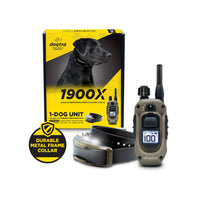 | Dogtra 1900X — $254.99 | All-around, medium–large dogs (35 lbs+) | 3/4 mile | 100 levels; Nick, Continuous, XPP vibration, Tone, Boost | View Dogtra 1900X on PetsTEK → |
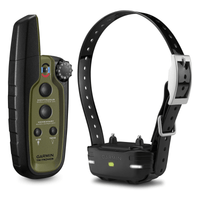 | Garmin Sport PRO Bundle — $299.99 | Field work, collar + handheld | 3/4 mile | 10 levels; Continuous, Momentary, Vibration, Tone, beacon lights, BarkLimiter | View Garmin Sport PRO on PetsTEK → |
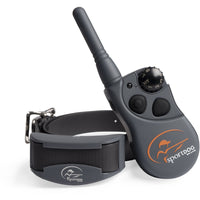 | SportDOG FieldTrainer 425X — $154.99 | Everyday training, best value | 500 yards | 21 levels; Nick, Constant, Tone, Pager vibration | View SportDOG 425X on PetsTEK → |
 | PetSafe 300 Yard Lite — $159.95 | Yard and neighborhood, simplest controls | 300 yards | 15 levels; Tone, Vibration, Static; safety lock | View PetSafe 300 Yard Lite on PetsTEK → |
A stim number is NOT comparable across brands — the ET-300’s 100 levels, the Sport PRO’s 10, and the 425X’s 21 are different scales. Compare fit, range, and modes, not raw level counts. Source: petstek.com live listings, checked October 26, 2026.
Free PDF: The 7-Day E-Collar Training Plan
Day 1 is fit + beep-only conditioning. Vibrate comes on Days 2–3. Low-stim recall on Days 4–5. Proofing on Days 6–7.
Frequently Asked Questions
How old should a puppy be before using a training collar?
At least 6 months old, and only once the puppy already knows the command on-leash. Before that, use positive reinforcement and on-leash training. A collar on a young puppy, or on a dog that has not learned the command yet, teaches nothing — it only confuses.
How long can my dog wear a training collar?
As a rule, no more than 8–12 hours, and off at night, always. Move the collar to a different spot on the neck every couple of hours, and check the skin every time you take it off. Follow your own model’s manual where it gives a shorter limit, and give a rest day if you see any redness.
How do I find my dog’s working level?
Start at level 1 with the dog standing calmly, tap stim briefly, and watch for the subtlest reaction — an ear flick, a head turn, a brief pause. Go up one level at a time until you get that mild, curious reaction. That is the working level; train at or just above it. Recheck it every session, because it varies by day and by distraction level.
Is beep and vibrate enough, or will I need stim?
Often, yes. Many dogs — especially small dogs — end up training on beep alone, or on beep and vibrate, and never need stim. Condition beep first, add vibrate second, and use stim only when beep and vibrate do not get a response to a known command. If you want no stim at all, a vibration-only collar (tone plus vibration) exists for exactly that.
What should I do if my dog yelps or shuts down?
Stop immediately, take the collar off, and do not train again that day. A yelp means the level is far too high; freezing, cowering, or refusing treats means the dog is stressed. Next session, go back at least two steps — usually to beep-only conditioning — and restart the working-level search from level 1. If shutdown happens twice, stop e-collar training and consult a professional trainer.
Are stim levels comparable between brands?
No. Each brand’s scale is relative to its own models only, so a level number on one collar means nothing on another. Never take level advice from someone with a different collar. Start at the bottom of your own collar’s scale and work up to the first mild reaction — your dog’s reaction is the measurement, not the number.
Are shock collars cruel?
It depends on how they are used, not on the tool alone. At a low working level, with a known command, correct timing, and rewards, a training collar is a communication tool. At high levels, as punishment after the fact, or on a fearful or aggressive dog, it is harmful — and that use should stop. If you are unsure whether your dog is a good candidate, work with a professional trainer before you start.
Related Guides
- Shock Collar for Dogs: The Complete Guide
- Best Shock Collar for Dogs
- Shock Collar for Small Dogs
- E-Collar vs Shock Collar
- Dogtra vs E-Collar Technologies
- Garmin vs PetSafe vs SportDOG
- Start at the homepage
This site is by PetsTEK. The collars above are products we sell — this page is written to help you use one safely, including when the answer is ‘not yet’ or ‘not this tool.’