
This site is by PetsTEK, the dog training gear store. The collars below are products we sell. This page explains what the different names mean — written so you shop correctly, including when the right answer is “not this tool” or “not yet.”
Key takeaways: An e-collar and a shock collar are the same tool — a receiver on the dog’s collar strap, controlled by a handheld remote. “Shock collar” is the older name from the 1980s–90s; trainers and brands now say “e-collar” or “remote training collar.” Modern collars use a beep, vibration, and low-level adjustable stimulation — most training happens on beep and vibration alone. Don’t confuse either term with bark collars (automatic, bark-triggered) or boundary collars (fence systems) — those are different tools with different jobs.
If you’ve been shopping, you’ve seen all three names: e-collar, shock collar, remote training collar. Are they different products? Mostly no. The names track the technology’s history — “shock collar” comes from an era of crude, high-output devices, and the industry moved on to “e-collar” as the tools got finer and gentler. Here’s what each term means, which brands use which name, and what the science says.
What Each Name Actually Means
“Shock collar” — the original popular term, from the 1980s and 90s, when training collars were crude single-level devices with a harsh punch. The word “shock” stuck even after the technology changed. It’s still the term most shoppers type into Google — which is why our site is named the way it is.
“E-collar” — short for “electronic collar.” The name trainers and manufacturers adopted as devices became multi-mode: tone, vibration, and adjustable low-level stimulation. E-Collar Technologies built its whole brand on the term (their Educator line: the Mini Educator ET-300 and Micro Educator ME-300).
“Remote training collar” / “remote trainer” — the plainest, most accurate name: you push a button on a handheld transmitter; a receiver on the dog’s collar strap responds. Dogtra calls its line “remote training collars” (the Dogtra 1900X), SportDOG calls them “remote trainers” (the FieldTrainer 425X), and Garmin calls the Sport PRO a “dog training collar.”
The Same Tool, Three Generations
The hardware changed a lot even while the words lagged behind:
- Generation 1 (1960s–80s): crude, high-output, single-level devices. This is where the word “shock” came from — and honestly earned it.
- Generation 2 (1990s–2000s): digital controls, adjustable levels, tone added. The tool becomes a communication device, not a cattle prod.
- Generation 3 (today): fine-grained, low-level stimulation platforms (up to 100 levels), vibration and tone you can train on without ever using stim, Pavlovian/conditioning tones, boost functions, fully waterproof builds.
This is an industry-wide arc, not a brand-by-brand claim — every major brand we sell at PetsTEK (Dogtra, E-Collar Technologies, Garmin, SportDOG, PetSafe) now sells generation-3-style collars. When someone says “shock collar” today, they almost always mean one of these modern devices.
Don’t Confuse Them With Bark or Boundary Collars
Different jobs, different tools:
| Type | How it works | Trigger | Example |
|---|---|---|---|
| Training collar (e-collar) | Handheld remote you operate | You press a button, for a specific command | Dogtra 1900X, Mini Educator ET-300 |
| Bark collar | Worn on the dog, activates automatically | The dog’s barking | PetSafe NoBark line, SportDOG NoBark |
| Boundary collar | Paired with a buried-wire or wireless fence | The dog crosses the set boundary | In-ground fence systems |
A bark collar corrects barking on its own; a training collar only does something when you tell it to. They are not interchangeable.
What the Brands Call Them — A Quick Decoder
Shopping across brands? This table maps each brand to the name it uses:
| Brand | What it calls its collars | Example on PetsTEK |
|---|---|---|
| Dogtra | “Remote training collar” / “e-collar” | Dogtra 1900X |
| E-Collar Technologies | “E-collar” | Mini Educator ET-300 |
| Garmin | “Dog training collar” | Garmin Sport PRO |
| SportDOG | “Remote trainer” | SportDOG FieldTrainer 425X |
| PetSafe | “Remote trainer” (training) / “Bark control” (bark) | Browse PetSafe options |
If a listing says “e-collar,” “shock collar,” or “remote trainer,” compare the specs — it’s almost certainly the same class of device.
What Modern Collars Actually Do
Every generation-3 collar on PetsTEK works the same basic way: a beep (tone), a vibration, and stimulation — used in that order.
- Beep: a short audible tone. Dogs learn to associate it with a command (often “come”); many dogs end up training on beep alone.
- Vibration: a buzz the dog feels. A step up from the beep; useful for deaf dogs.
- Nick: a split-second pulse. Continuous: stays on while you hold the button (most collars cut off after 10–12 seconds).
- Boost: a preset jump to a higher level for emergencies (stopping a chase), on some models.
One honest note: a stim scale is not comparable across brands. “Level 40” on one brand is not the same output as “level 40” on another — 100 levels on one brand doesn’t mean “more powerful” than 21 on another. Compare ranges and modes, not raw numbers, across brands.
What the Research Says
Two sources worth knowing before you decide:
- Cooper et al. (2014), published in the peer-reviewed journal PLoS ONE, studied 63 pet dogs trained with e-collars by industry-approved trainers following manufacturer guidelines, versus reward-based groups. The e-collar dogs showed more stress signals (tension, yawning, less engagement with their environment) and no consistent efficacy advantage. Source: Read the study in PLoS ONE
- The American Veterinary Society of Animal Behavior’s 2021 Position Statement on Humane Dog Training recommends that only reward-based methods be used for all dog training, and advises that aversive methods — electronic collars included — should not be used. Source: AVSAB Position Statements
Our honest take, as the store that sells these: they are tools some trainers use successfully at low levels. These studies highlight why old-school, high-level correction is a mistake. Modern e-collar training isn’t a replacement for positive reinforcement — when you teach commands with rewards first and use tone, vibration, or the lowest working level solely as an off-leash tap on the shoulder, you avoid the stress seen in high-stim protocols. Train the command first, use the lowest level the dog notices, and if your dog has fear or aggression issues, hire a professional trainer before buying any collar. Some countries and regions restrict electronic collars — check the rules where you live.
The Collars on PetsTEK — Compared
| Product photo | Collar | Best for | Range | Stim Levels / Modes | Check price |
|---|---|---|---|---|---|
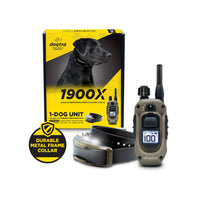 |
Dogtra 1900X | All-around, medium–large dogs (35 lbs+) | 3/4 mile | 100 levels; Nick, Continuous, XPP vibration, Tone, Boost | View Dogtra 1900X on PetsTEK → |
 |
Mini Educator ET-300 | Small–medium dogs, first-timers (15 lbs+) | 1/2 mile | 100 levels; Nick, Continuous, Vibration, Pavlovian tone, Boost (1–60) | View Mini Educator ET-300 on PetsTEK → |
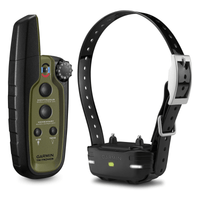 |
Garmin Sport PRO (bundle) | Hunting and field work (collar + handheld) | 3/4 mile | 10 levels; Continuous, Momentary, Vibration, Tone | View Garmin Sport PRO Bundle on PetsTEK → |
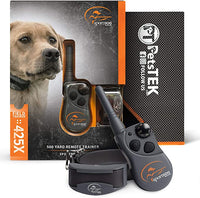 |
SportDOG FieldTrainer 425X | Everyday training, best value | 500 yards | 21 levels; Nick, Constant, Tone, Pager vibration | View SportDOG 425X on PetsTEK → |
Source: petstek.com live listings, checked October 23, 2026. Prices change — click through for the current price and stock.
Free PDF: The 7-Day E-Collar Training Plan
Day 1 is fit + beep-only conditioning. Vibrate comes on Days 2–3. Low-stim recall on Days 4–5. Proofing on Days 6–7.
Choosing Quick-Check
A short version of our choosing guide — the same six checks every “best” list should pass:
- Size and fit — match the receiver to your dog’s neck; small dogs need small receivers (see our Small Dogs guide).
- Stim levels — finer granularity (more levels) means easier fine-tuning on sensitive dogs.
- Range — 400–800 yards for the yard; 3/4 mile+ for field work. Don’t pay for range you won’t use.
- Waterproofing — fully waterproof if your dog swims, not just water-resistant.
- Battery — rechargeable is standard; check run time.
- Warranty and support — established brands have real warranties; cheap no-name collars often have inconsistent stim levels.
Full walkthrough: Shock Collar for Dogs: The Complete Guide.
When NOT to Use One
Be honest with yourself before buying:
- Puppies under 6 months — they learn through positive reinforcement first.
- Dogs with fear or aggression problems — get a professional trainer first; a collar can make these worse.
- As punishment after the fact — the dog won’t connect it to the behavior.
- On a dog that hasn’t learned the command yet — the collar reinforces; it doesn’t teach.
- If your dog yelps, cowers, or runs from you — the level is too high, the timing is off, or the dog isn’t ready. Stop and go back a step.
Frequently Asked Questions
Is an e-collar the same as a shock collar?
Yes — same tool, different era of language. “Shock collar” is the older name from the 1980s–90s, when devices were crude and harsh. Modern collars are multi-mode devices with a beep, vibration, and low-level adjustable stimulation, and trainers and brands now call them e-collars or remote training collars.
Why is it still called a shock collar if it doesn’t shock?
Old habits. The name stuck from the first generation of devices. Search data shows most shoppers still type “shock collar,” so stores and guides keep the term — but the modern device it describes is a fine-grained training tool, not the blunt instrument the name suggests.
What’s the difference between an e-collar and a bark collar?
An e-collar (training collar) only does something when you press a button on the remote, and it’s for reinforcing known commands. A bark collar activates automatically when the dog barks. Different tools, different jobs — one doesn’t replace the other.
Do professional trainers still use e-collars?
Some do, and some won’t touch them. The veterinary behavior community (AVSAB’s 2021 position statement) recommends reward-based methods only. Among working-dog and hunting trainers, e-collars remain common. If you use one, train the command first and use the lowest level your dog notices.
What does the research say about e-collars?
The best-known study (Cooper et al., 2014, PLoS ONE) found that dogs trained with e-collars showed more stress signals than reward-trained dogs, with no consistent efficacy advantage — even when trainers followed manufacturer guidelines. No major body of research shows e-collars outperforming reward-based training.
What should I search for when shopping?
Any of the names — e-collar, shock collar, remote training collar, remote trainer — will find the same class of device. Compare specs (range, modes, stim levels) rather than names, and remember that stim level numbers aren’t comparable across brands.
Are e-collars legal?
Rules differ by country and region — some restrict or ban electronic collars. Check the rules where you live before buying.
Related Guides
- Shock Collar for Dogs: The Complete Guide — choosing, fitting, settings, and the 7-day training sequence.
- Best Shock Collar for Dogs — our picks ranked by dog size and training need.
- Shock Collar for Small Dogs — sizing, fit, and lowest effective settings for small necks.
- Start at the homepage