
By the PetsTEK Training Team · Updated October 2026
This site is by PetsTEK, the dog training gear store. Dogtra and E-Collar Technologies are the two brands we sell most — this guide compares them honestly, including where each one is the wrong choice. Every price and spec below was checked against live PetsTEK listings on October 24, 2026.
Quick answer: Neither brand is “better” — they fit different hands and different dogs. Pick Dogtra if you want a rugged field build, a dial-style remote, and the widest range of receiver sizes (the 1900X is the workhorse). Pick E-Collar Technologies if you want the gentlest, most fine-grained stimulation for a small or sensitive dog, a stopwatch-style remote, and the lock-and-set safety feature (the ET-300 is the classic first-timer pick). The table below compares the six in-stock models that matter most.
Dogtra and E-Collar Technologies (sold as “Educator”) dominate the serious end of training collars, and for good reason: both build waterproof, rechargeable, multi-mode systems with real warranties and real support. But they feel different in the hand, they think about stimulation differently, and their lineups solve different problems. Here’s how they compare — model by model, with live PetsTEK prices — so you buy the right brand the first time.
The Two Brands at a Glance
| Brand | Remote style | Stimulation approach | Expandability | Best known for |
|---|---|---|---|---|
| Dogtra | Rheostat dial (twist to set the level) on most models | Low-to-high output; newer X-series uses 100 levels with Boost | Most systems expand to 2–3 dogs | Rugged field builds; the 1900X workhorse; GPS tracking line (Pathfinder) |
| E-Collar Technologies | Stopwatch-style remote (small, round, one-handed) | “Blunt pulse” stimulation — designed to feel gentler at the same level; 100 levels + 1–60 boost; Lock & Set prevents accidental level changes | Most systems expand to 2 dogs | Small-dog specialists; the ET-300/ME-300 pair; vibration-focused options |
Note: A stim number is NOT comparable across brands — Dogtra’s 127-level classics and Educator’s 100 levels are different scales. Compare fit, range, and modes, not raw level counts.
Head-to-Head: The Six Models That Matter
| Product | Model | Best for | Range | Stim Levels & Modes | Check price |
|---|---|---|---|---|---|
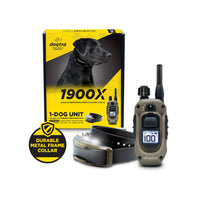 | Dogtra 1900X — $254.99 | All-around, medium–large dogs (35 lbs+) | 3/4 mile | 100 levels; Nick, Continuous, XPP vibration, Tone, Boost | View Dogtra 1900X on PetsTEK → |
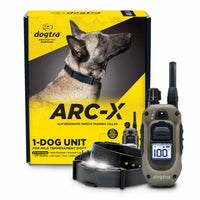 | Dogtra ARC-X — $254.99 | Slim fit, medium–large dogs (15 lbs+) | 3/4 mile | 100 levels; Nick, Continuous, XPP vibration, Tone, Boost | View Dogtra ARC-X on PetsTEK → |
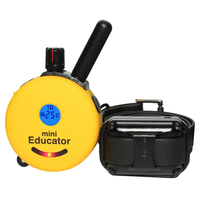 | Mini Educator ET-300 — $199.99 | Small–medium dogs, first-timers (8 lbs+) | 1/2 mile | 100 levels; Nick, Continuous, Vibration, Pavlovian tone, Boost 1–60 | View Mini Educator ET-300 on PetsTEK → |
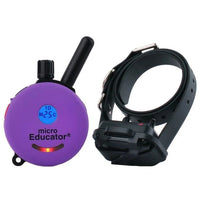 | Micro Educator ME-300 — $199.99 | Smallest dogs (5 lbs+), sensitive dogs | 1/3 mile | 100 levels; same modes as ET-300, ~20% gentler output | View Micro Educator ME-300 on PetsTEK → |
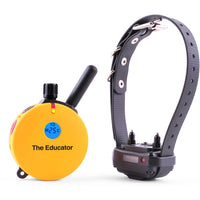 | Educator ET-400 — $219.99 | Longer range with the Educator feel (5 lbs+) | 3/4 mile | 100 levels; Nick, Continuous, Vibration, Tone, Boost 1–60 | View Educator ET-400 on PetsTEK → |
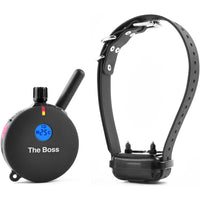 | Boss Educator ET-800 — $279.99 (1-dog; 2-dog system $399.99) | Large, stubborn, high-drive dogs (30 lbs+) | 1 mile | 100 levels + Boost 1–60; higher output above level 50 | View Boss Educator ET-800 on PetsTEK → |
Prices checked against live PetsTEK on Oct 24, 2026 — click through for the current price and stock. Source: petstek.com live listings.
Dogtra in Depth
Dogtra’s identity is the dial. On most Dogtra remotes you twist a rheostat dial to set the level — fast, tactile, and easy with gloves on. The current X-series (1900X, ARC-X) adds tone, XPP vibration, boost, an LED locate light, and a level lock to the classic formula, so the level can’t drift in a pocket.
Dogtra receivers run the full size range: the ARC-X’s slim receiver fits a 15-lb dog’s neck, while the 1900X is a robust unit for 35-lb-and-up dogs. The 1900X expands to three dogs on one remote — the only system here that does — and Dogtra also sells the Pathfinder GPS tracking line if tracking matters to you (a different tool, not a training collar).
One honest note: Dogtra’s classic 280C is sold out at PetsTEK as of October 24, 2026, so it isn’t in the table above — the ARC-X is the closest in-stock Dogtra alternative at the same $254.99 price point.
Choose Dogtra if: you train outdoors in rough conditions, you like a dial, you run multiple dogs, or you want the longest track record in field work.
Dogtra’s honest limitation: the dial that field trainers love can be bumped in a pocket on models without a level lock — if that worries you, pick an X-series model (lock included) or an Educator (Lock & Set standard).
E-Collar Technologies in Depth
Educator’s identity is the stopwatch remote: small, round, designed for one hand, with the level on an LCD and a lock-and-set feature that stops accidental changes. The stim itself is a “blunt pulse” — deliberately shaped to feel less sharp than a standard pulse at the same level — which is why Educator is the default recommendation for sensitive dogs and first-timers.
The lineup is a ladder: ME-300 (smallest, gentlest) → ET-300 (the classic) → ET-400 (same feel, 3/4-mile range) → EZ-900 ($229.99, easy-grip remote, 1/2-mile range) → ET-800 “The Boss” (1-mile range, extra output above level 50 for stubborn, high-drive dogs). The FT-330 Finger Trainer ($249.99) is the ET-300 with a finger-button remote for hands-free use. Every Educator here expands to two dogs, and all are fully waterproof with 2-hour rapid-charge batteries and a 2-year warranty.
Choose Educator if: your dog is small or sensitive, you’re buying your first collar, you want the gentlest stim available, or you want the lock-and-set safety feature.
Educator’s honest limitation: the stopwatch remote is small — trainers with big hands or gloves sometimes prefer Dogtra’s larger dial remote. And Educator’s top range (1 mile on the ET-800) matches but doesn’t beat Dogtra’s field/GPS options.
Which Brand for Which Dog
| Your situation | Pick | Why |
|---|---|---|
| Small dog under ~15 lbs | Micro Educator ME-300 | Smallest receiver, gentlest output, fits 5-lb dogs |
| First training collar | Mini Educator ET-300 | Easiest remote to learn, gentle stim, lock-and-set |
| All-around medium–large dog | Dogtra 1900X | Widest capability, 3-dog expansion, rugged build |
| Slim fit for a medium dog | Dogtra ARC-X | Slim receiver shaped to the neck, 3/4-mile range |
| Stubborn or high-drive large dog | Boss Educator ET-800 | Extra output above level 50, 1-mile range |
| Educator feel, longer range | Educator ET-400 | Same 100-level platform as the ET-300, 3/4-mile range |
| Two dogs, one remote | ET-300 or 1900X | Both expand; the 1900X goes to three dogs |
Buying Guide: Look For / Avoid
Range reality — Look for: a range that matches your real training distance (yard/park: 1/3–1/2 mile is plenty; field: 3/4 mile+). Avoid: paying for miles you’ll never use, or trusting “up to” range claims — hills, trees, and buildings cut real-world range.
Mode flexibility — Look for: tone + vibration + stim on the same collar, so most training happens without stim. Avoid: single-mode collars and any collar where you can’t train on tone/vibration alone.
Battery reality — Look for: rechargeable lithium batteries with a 2-hour rapid charge (standard on both brands here). Avoid: collars with disposable batteries or vague run-time claims.
Fit — Look for: a receiver sized to your dog’s neck (see the min weights in the table). Avoid: buying the “best” collar in a size your dog can’t wear — an oversized receiver on a small dog is the most common buying mistake.
When NOT to Use One
- Puppies under 6 months — positive reinforcement first.
- Dogs with fear or aggression problems — hire a professional trainer first; a collar can make these worse.
- As punishment after the fact — the dog won’t connect it to the behavior.
- On a dog that hasn’t learned the command yet — the collar reinforces; it doesn’t teach.
- If your dog yelps, cowers, or runs from you — the level is too high, the timing is off, or the dog isn’t ready. Stop and go back a step.
Free PDF: The 7-Day E-Collar Training Plan
Day 1 is fit + beep-only conditioning. Vibrate comes on Days 2–3. Low-stim recall on Days 4–5. Proofing on Days 6–7.
Frequently Asked Questions
Which brand is better, Dogtra or E-Collar Technologies?
Neither — they fit different dogs and hands. Dogtra suits field work, dial remotes, and multi-dog setups (the 1900X expands to three dogs). Educator suits small or sensitive dogs, first-timers, and anyone who wants the gentlest stim with a lock-and-set safety feature (the ET-300 is the classic first pick).
Is Dogtra stronger than Educator?
You can’t compare the numbers directly. Dogtra’s level scales and Educator’s 100 levels are different scales — a level number on one brand is not the same output on the other. The real difference is feel: Educator’s blunt-pulse stim is designed to feel gentler, while Dogtra’s low-to-high output covers a wider range of dog sizes and temperaments.
Which is best for a small dog?
The Micro Educator ME-300 — it’s sized for dogs as small as 5 lbs and runs about 20% gentler than the ET-300. The Dogtra ARC-X is the slim-fit alternative for medium dogs (15 lbs and up).
Which remote is easier for a beginner?
The Educator stopwatch remote (ET-300/ME-300) — small, one-handed, with an LCD level readout and lock-and-set so the level can’t drift accidentally. Dogtra’s dial remote is faster for experienced trainers but easier to bump on models without a level lock.
Can I train two dogs with one remote?
Yes, with both brands — every Educator system here expands to two dogs, and Dogtra’s 1900X expands to three. Buy the second receiver for the same system; check the product page for the matching receiver.
Do these collars work for stubborn dogs?
For large, high-drive dogs, the Boss Educator ET-800 adds extra output above level 50 over a 1-mile range, and the Dogtra 1900X covers the same ground with a rugged build. But no collar fixes a command the dog hasn’t learned — train the command first, then reinforce it at the lowest level the dog notices.
Related Guides
- Shock Collar for Dogs: The Complete Guide — choosing, fitting, settings, and the 7-day training sequence.
- Best Shock Collar for Dogs — our picks ranked by dog size and training need.
- Shock Collar for Small Dogs — sizing, fit, and lowest effective settings for small necks.
- E-Collar vs Shock Collar — what the different names mean and what the research says.
- Start at the homepage